Meet C.
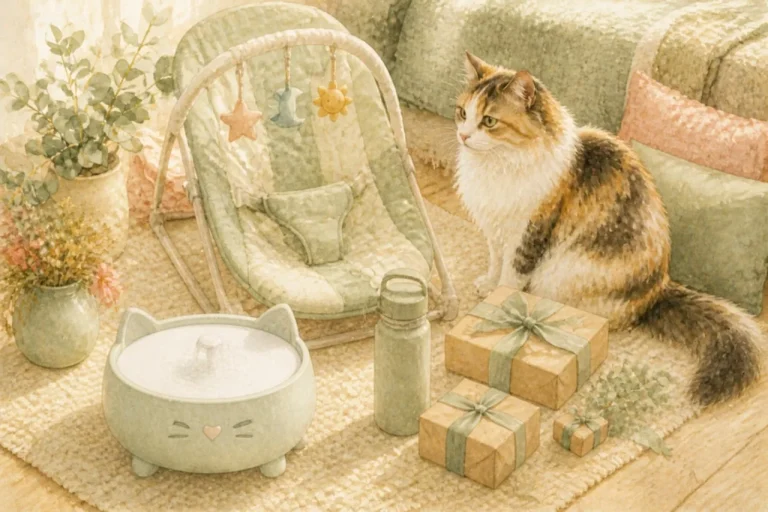
Before Raf, before the wedding, before almost everything, there was C.
I was 24 when we adopted her, a tiny long-haired calico kitten. She’s 13 now, and she’ll turn 14 in January. Without planning it, she became my companion for my whole adult life. She watched me study and graduate. She was there when I started my life with my partner and when we moved into our first apartment. She saw my first jobs, our wedding, my first business, my pregnancy… and now, Raf.
She’s not an easy cat, and I love her for it. She doesn’t like being bothered, and she really doesn’t like anyone invading her space, except for me and my partner. When someone gets too close, she usually walks away and hides in my bedroom, her favorite place in the house. Other days, she stands her ground and hisses.
So when Raf arrived, her quiet world changed overnight.
Cats are smart, and C always knew Raf was part of her pack. That didn’t mean she was going to make things easy. When Raf started crawling, C became the number one goal. Raf would put every ounce of energy into crawling toward her… and right before Raf got there, C would simply get up and walk away, without even looking back. She never once waited. Honestly, I think she was the best crawling coach Raf could have had.
Today she lets Raf pet her. On her terms, and everything in moderation. But every time I see them side by side, the one who has been with me through everything and the one who changed everything, my heart feels full.
That’s why, in our home, keeping Raf safe also means protecting C’s space. Here’s what has worked for us.
The short version
- Use a covered litter box with a door, in a place your baby can’t get to. Ours is on the terrace.
- Keep the scoop up high, where your baby can’t see it or grab it.
- Add a litter mat so less litter ends up on the floor where your baby crawls.
- Use a simple, unscented clumping litter. A “fancy” one once made C go outside her box.
- Give your cat cat doors, and give yourself doors you can close.
- Teach your baby early, calmly and every time: the litter box and the cat food are not for them.
Why the Litter Box Matters So Much With a Baby
Babies explore with their hands and their mouths. A litter box is full of things that should never go in a baby’s mouth: used litter, cat waste and the germs and parasites it can carry. Litter itself can also be a choking risk for little ones.
And it’s not only about your baby. For a cat, the litter box is one of the most private places in the house. If a curious baby keeps showing up there, some cats get stressed and start going outside the box. Keeping your baby out protects both of them.
1. Choose a Covered Litter Box With a Door
For me, this is the most important thing: the litter box should be covered and have a door. A baby can’t see inside, can’t dig in it and can’t easily reach in. And C still gets her privacy.
Ours sits right on the floor, and it isn’t fancy at all. It cost around $30, and I bought it a long time ago. It’s been so good that I’ve never had to replace it. You don’t need a high-tech box to keep your baby out. You need a closed one with a door.
That’s why I’m recommending the one on Amazon that looks the most like mine.
2. Put It Where Your Baby Doesn’t Go
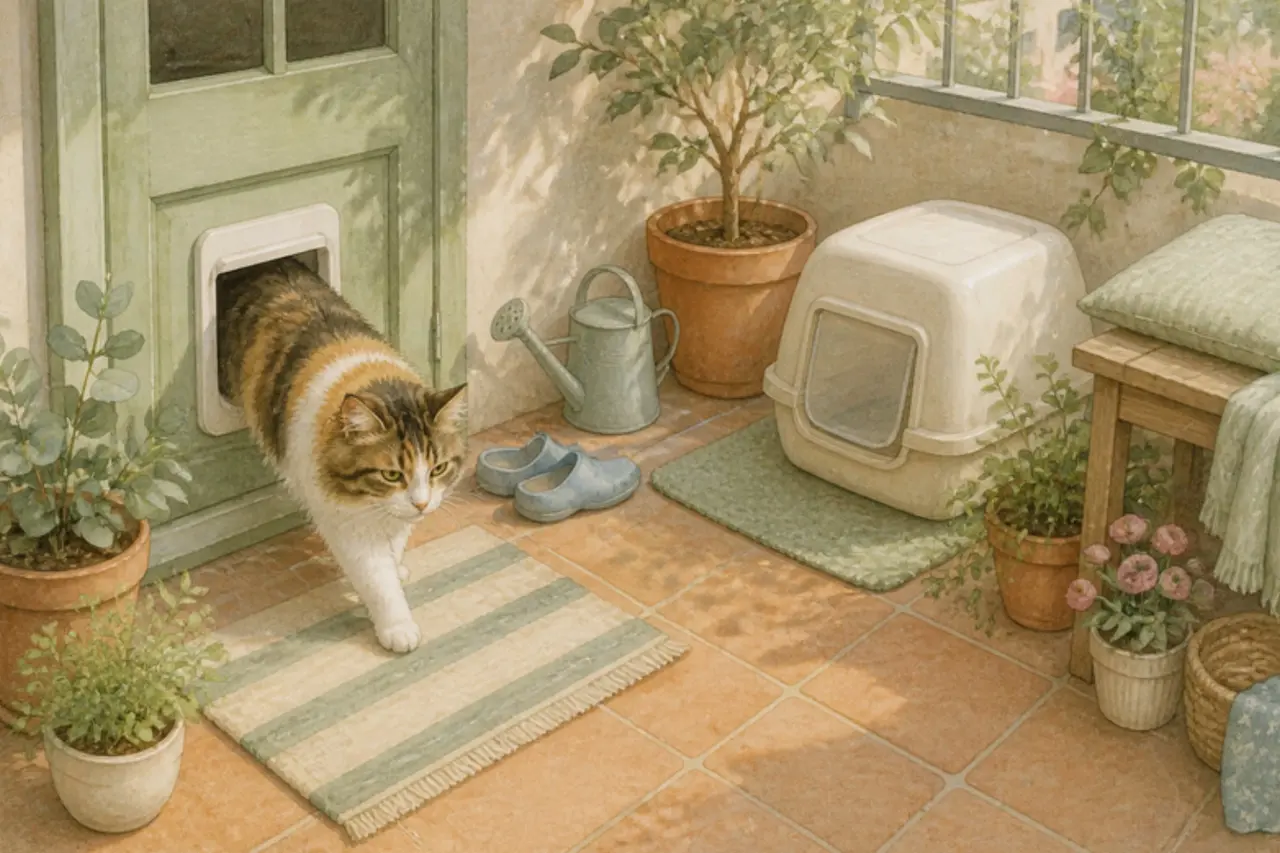
Where you put the box matters as much as the box itself. C’s litter box is out on our terrace. She gets there through a cat door in the kitchen door, whenever she wants. Raf stays inside, and the litter box stays out of sight and out of reach.
If you don’t have a terrace or balcony, look for a place that’s quiet for your cat and “boring” for your baby: a laundry room or a bathroom you can keep closed, never the living room, never next to the play mat and never in a hallway your baby crawls through every day.
3. Keep the Scoop Up High
This is a small thing that makes a big difference. We keep the litter scoop up high, where Raf can’t see it or use it. If a baby can see a shovel and a box of “sand,” that’s an invitation to play.
The same goes for litter bags, refills and anything else that lives near the box: up and out of sight.
4. Add a Litter Mat
Cats always kick a little litter out of the box. With a baby crawling around, that’s litter on the floor at exactly your baby’s level. A good litter mat catches most of it.
5. Choose a Simple, Unscented Litter (C Taught Me This One)
For a few weeks, C pooped outside her litter box, and I kept wondering what was going on. Was it a behavior problem? Was she upset about something?
At the time, I was buying her a very fancy litter. At least, that’s what I thought. I’d been buying the same one for a long time, and at first it hadn’t been a problem at all.
Then one day I ran out and had to grab a random litter at the supermarket. A few days later, I realized what had been happening: C didn’t like the fancy litter. I’m convinced it hurt her little paws, and that’s why she was going outside the box.
So I started looking for something different: a basic litter that clumps really well. No perfume, nothing fancy. Since then, she’s been back to using her box.
What I’d look for today:
- Unscented. Cats have a much stronger sense of smell than we do, and many don’t like perfumed litter.
- Strong clumping, so you can scoop it easily and the box stays clean longer.
- Fine, soft granules that feel gentle on their paws.
- Low dust, which is better for your cat, and nicer in a home with a baby too.
6. Give Your Cat Doors (and Yourself Doors You Can Close)
This is honestly the best thing we’ve done for living with a baby and a cat. We have two cat doors: one in the kitchen door, so C can go out to the terrace (and to her litter box), and one so she can get into my bedroom.
C has her freedom and a place to hide whenever she needs it. And I can close the doors and keep certain spaces off-limits for Raf, without locking C out of her favorite places.
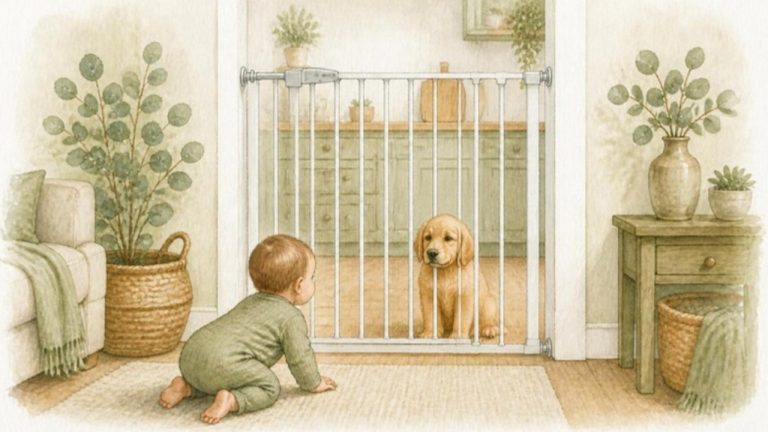
If you can’t install a cat door (for example, if you rent), a baby gate with a small cat door built in is a good option: your cat walks through, and your baby stays on the other side.
7. What About the Cat Food?
The litter box gets all the attention, but the cat food is just as tempting for a crawling baby. Kibble is the perfect size for little fingers, and a cat might swat if someone gets too close to her food.
C eats from a food tree, a little tower where she has to work a bit to get her food out. It keeps her mind active. I’ll be honest: Raf can reach it. So instead of hiding it, I’ve taught Raf that it’s C’s food and that Raf can’t go near it. So far, it’s worked.
For water, C has a fountain and a simple glass bowl in the dining room that she drinks from every day. After trying I don’t know how many fountains, the Catit was the only one she liked: its low edges don’t bother her whiskers.
8. Teach Your Baby Early (and Calmly)
No setup is perfect, and babies are fast. That’s why teaching matters too.
Whenever Raf showed even a little interest in the litter box, I calmly explained that it’s C’s and that Raf can’t go near it. I said the same thing, the same way, every time. So far, Raf doesn’t go near it.
You don’t need to scare your baby. A calm “no, that’s C’s” and gently moving your baby away works better than a big reaction, which can make the forbidden spot even more interesting.
Give Your Cat a Baby-Free Escape
All of this works better when your cat has somewhere to go. For C, it’s my bedroom, behind her cat door. When the house gets too loud, she disappears there, and she comes back when she’s ready.
A high spot works too. A window perch gives a cat a place to rest, watch the world and stay out of reach. C doesn’t have one yet, but I only recently found out they exist, and I’m thinking of getting her one.
Frequently Asked Questions
How do I keep my baby out of the litter box?
Use a covered litter box with a door, put it in a room your baby doesn’t usually go into, keep the scoop up high and add a litter mat. Cat doors or a baby gate with a cat door let your cat in and keep your baby out.
Is cat litter dangerous for babies?
It can be. Used litter and cat waste can carry germs and parasites, and litter can be a choking risk for small children. If your baby puts litter or cat waste in their mouth, call your pediatrician. In the US, you can also call Poison Control at 1-800-222-1222.
What if my baby eats cat food?
A small taste of dry cat food usually isn’t an emergency, but kibble can be a choking risk for babies, and it isn’t made for them. Keep the feeding spot supervised or out of reach, and call your pediatrician if you’re worried.
Why is my cat pooping outside the litter box?
It can be the litter. C did this for a few weeks, until I switched from a “fancy” litter to a simple, unscented clumping one. It can also be stress, a dirty box or a health problem, so check with your vet first, especially if it starts suddenly.
Should I move the litter box when my baby starts crawling?
If the box is in a spot your baby will reach, yes, but move it gradually, a little at a time, and keep it somewhere quiet. Cats don’t like sudden changes to their litter box.
C, Raf and Me
Living with a baby and a cat isn’t about keeping them apart forever. It’s about giving each of them their own space, so they can share the rest of the house in peace. C has her doors, her bedroom and her food. Raf has the whole rest of the house to explore. And I get to watch them, side by side, more often every day.