My birth didn’t go the way I had imagined. I ended up with a C-section, and for a while, my scar felt like a constant reminder that something had gone wrong.
That’s the part nobody talks about. Caring for a C-section scar isn’t only physical. Sometimes the hardest step is simply being able to look at it.
Four weeks after my C-section, my OB told me it was time to start caring for my scar with silicone sheets and gentle massage with oil. I did it every day. I never developed adhesions or a keloid, and today my scar is something I can look at with a lot more peace.
Here’s exactly what I used, how I did it, and where you can buy it in the US.
Important: I’m a mom sharing my experience, not a doctor. Only start scar care once your incision is completely closed (no scabs, stitches, oozing or open spots), and always ask your OB or midwife first. Every recovery is different.
Quick Picks: What I Recommend
| Best for | Why | |
|---|---|---|
| Biodermis Epi-Derm C-Strip | The one I used | Clear, reusable medical-grade silicone strip in the perfect size for a C-section scar (1.4″ x 6″) |
| ScarAway C-Section Sheets | Best value | Made for C-section scars, 4 sheets per box, the most recommended option in the US |
| Weleda Stretch Mark Massage Oil | Massage oil | The exact oil I used: a sweet almond oil blend |
When I Started (and When You Can)
My OB gave me the green light 4 weeks after my C-section. Many doctors suggest starting somewhere between 2 and 6 weeks, once the incision is fully closed. Don’t start earlier just because you’re eager. Silicone and oils should never go on an open or healing wound.
Call your doctor if you notice: redness that spreads, warmth, swelling, oozing, the incision opening, fever, or pain that gets worse instead of better.
Step 1: Silicone Sheets (Day and Night)
I wore silicone sheets day and night, only taking them off to shower and to wash my scar and the sheet. My doctor prescribed them for 3 months, and I ended up using them for 4, because I had one strip left over. Silicone sheets keep the scar hydrated and protected, which helps it heal flatter and softer. In studies, the benefit showed up when people wore them many hours a day (12+) for at least 2 to 3 months. Consistency matters more than anything.
I used Epi-Derm silicone strips. Here’s the one I used, plus a more budget-friendly option:
Biodermis Epi-Derm C-Strip: The One I Used
- 1.4″ x 6″, the right size and shape for a C-section scar
- Clear, so it’s discreet under clothes (there’s also a beige, fabric-backed version)
- Medical-grade silicone gel, washable and reusable
- Designed for C-section and other surgical scars
- How long it lasts: each strip lasted me about a month. I bought one first to try it, and once I knew it worked for me, I found a pack of 3 and bought it
- Keep in mind: it’s sold one strip at a time (there’s also a 5-pack). For a 3-month treatment, plan on about 3 strips
ScarAway C-Section Sheets: Best Value
- 1.5″ x 7″, made to fit a C-section incision
- 4 sheets per box, each reusable for about 7 to 10 days
- Medical-grade silicone, beige color
- Keep in mind: each sheet lasts less, so you’ll probably need more than one box for a full 2 to 3 months
How to Use Silicone Sheets
- Wash and dry the scar and your hands.
- Apply the sheet directly over the scar, sticky side down. You can trim it to size.
- Wear it as many hours as you can, ideally 12 or more a day.
- Wash the sheet daily with mild soap and water, let it air-dry, and reapply.
- Replace it when it stops sticking.
Tip from experience: high-waisted postpartum underwear helps keep the sheet in place.
Step 2: Massage With Oil (3 Simple Moves)
Once your doctor says it’s OK, gentle massage helps keep the skin and the tissue underneath the scar soft and mobile, so it doesn’t “stick” to the layers below. Those are the adhesions I wanted to avoid.
I used Weleda Stretch Mark Massage Oil, a sweet almond oil blend (it also contains jojoba, wheat germ and arnica), and I did these 3 moves:
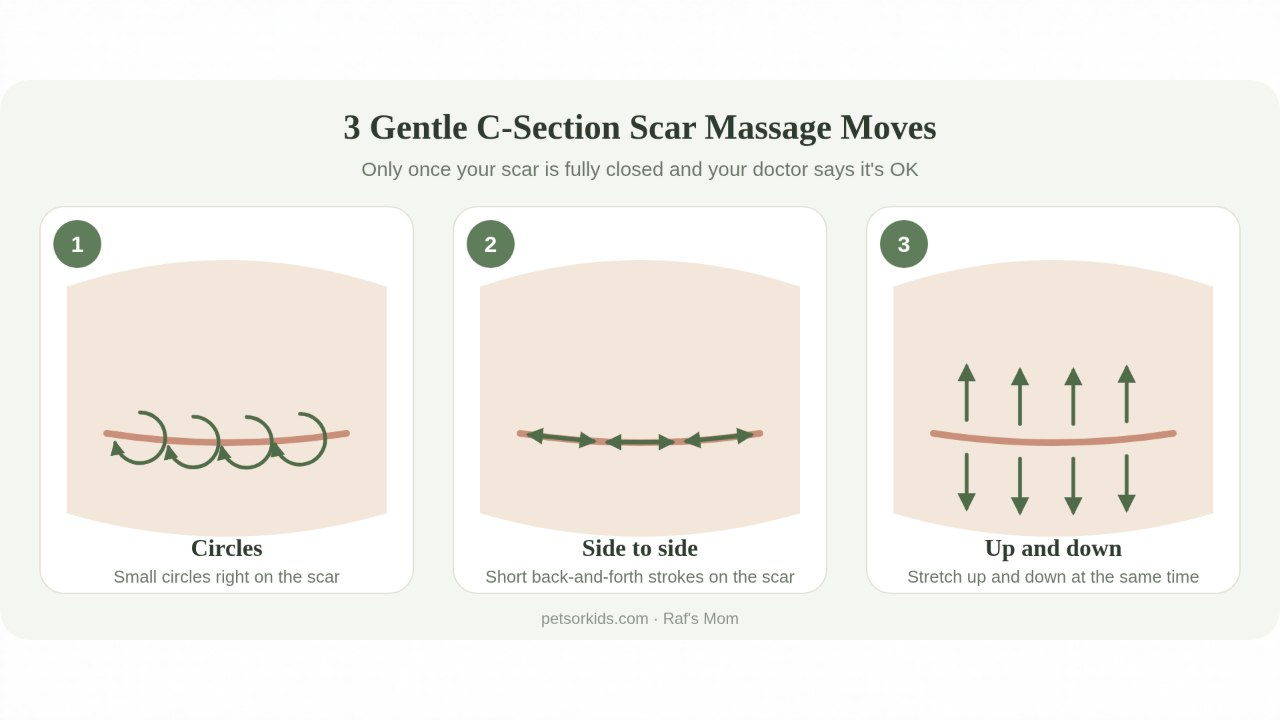
1. Circles. With two fingers, make small, slow circles right on the scar, moving from one end to the other.
2. Side to side. Place your fingers on the scar and make short back-and-forth strokes, horizontally, little by little along its whole length.
3. Up and down. Place the fingers of one hand just above the scar and the fingers of the other hand just below it. Then, at the same time, gently stretch the skin upward with the top hand and downward with the bottom hand. Move little by little along the whole scar.
How I did it: a few minutes a day, with a little oil, using gentle pressure. It should feel like a stretch, never sharp pain. At first the area may feel numb or strange. That’s very common after a C-section.
Weleda Stretch Mark Massage Oil: The Oil I Used
- A sweet almond oil base, with jojoba, wheat germ oil and arnica
- It has a soft, subtle scent, and it absorbs quickly without leaving your skin feeling greasy
- Keep in mind: it contains arnica and wheat germ. Don’t use it on broken skin, and skip it if you’re allergic to wheat or sensitive to fragrance
You don’t need a fancy oil for the massage itself. Any gentle oil your doctor approves will do. I chose this one because I still had some left from my pregnancy, and since it’s also designed for stretch marks, I could use it on my whole belly.
The Part Nobody Tells You: Making Peace With Your Scar
For me, the hardest part wasn’t the daily routine. It was taking the first step. My birth didn’t go the way I had hoped, and every time I looked at my scar, it reminded me that something had gone wrong. At first, even touching it was hard.
If you feel that way, you’re not alone, and you didn’t fail. A C-section is a birth. Your scar is the place your baby came into the world.
During those first months, I couldn’t quite make peace with the idea that what really mattered was that my baby was healthy and hadn’t suffered any lasting effects from the birth. Today I understand it. The way my birth ended was the best thing that could have happened. My baby could have suffered a lot during the birth, and my doctor made the best possible decision by ending it with an emergency C-section.
It wasn’t my fault. And if your birth didn’t go as planned either, it wasn’t yours. Today, when I look at my scar, I don’t see what went wrong. I see the day my baby arrived safely in my arms.
What helped me was turning scar care into a few minutes that were just for me, not just another task. Little by little, touching it with care helped me feel differently about it.
If your birth experience still weighs on you, talk about it with your doctor, a therapist or someone you trust. In the US, Postpartum Support International offers a free helpline at 1-800-944-4773 (call or text).
My Results
With the silicone sheets every day and my 3 massage moves, I didn’t develop adhesions or a keloid. I can’t promise the same for everyone, because every body heals differently. But I’m glad I started when my doctor said it was time, and that I kept going.
What I’d Do Differently
- Start the emotional part sooner. I’d talk earlier about how my birth made me feel.
- Set a daily reminder. Consistency is everything, and with a newborn, one day runs into the next, so it’s easy to forget.
- Plan your strips for the whole treatment. I bought one strip first to try it, then found a pack of 3 and bought it. If you already know it works for you, buying for the full 3 months from the start means you won’t have to stop halfway.
Frequently Asked Questions
When can I start using silicone sheets on my C-section scar? Only when the incision is completely closed, usually a few weeks after birth. My OB told me to start at 4 weeks. Always check with your doctor.
How many hours a day should I wear silicone sheets? As many as you can. Most guidance suggests 12 or more hours a day for at least 2 to 3 months. I wore mine day and night, taking them off only to shower and to wash them.
Can I massage my C-section scar with any oil? Usually, yes, as long as your skin is fully healed and you’re not allergic to it. Ask your doctor, especially if your oil contains essential oils or arnica.
Do silicone sheets work on old C-section scars? They tend to help most on newer, raised or red scars. They can still help older ones, but results are usually slower.
What if my scar is painful, numb or bulging? Numbness is common. Pain, a bulge above the scar (“shelf”), or discomfort that doesn’t improve are worth checking with your doctor. A pelvic floor physical therapist can also help with scar mobility.
The Bottom Line
Caring for my C-section scar took two things: silicone sheets day and night and a few minutes of gentle massage. It also took something less obvious, which was making peace with how my birth happened.
If you’re starting this journey, be gentle with your body and with yourself.
Struggling with breastfeeding pain too? Read my guide to the best nursing pillow for breastfeeding.
This article shares personal experience and general information. It isn’t medical advice. Always follow your doctor’s guidance for your recovery.

Written by Raf’s Mom
Baby and mom gear from real experience. Dog guides built from vet advice and owner reviews.